Missing drawings are the normal condition of industrial equipment in a small shop. A control panel can still be traced, because a control circuit is a chain of permissions and the open link can be found by testing the sequence.
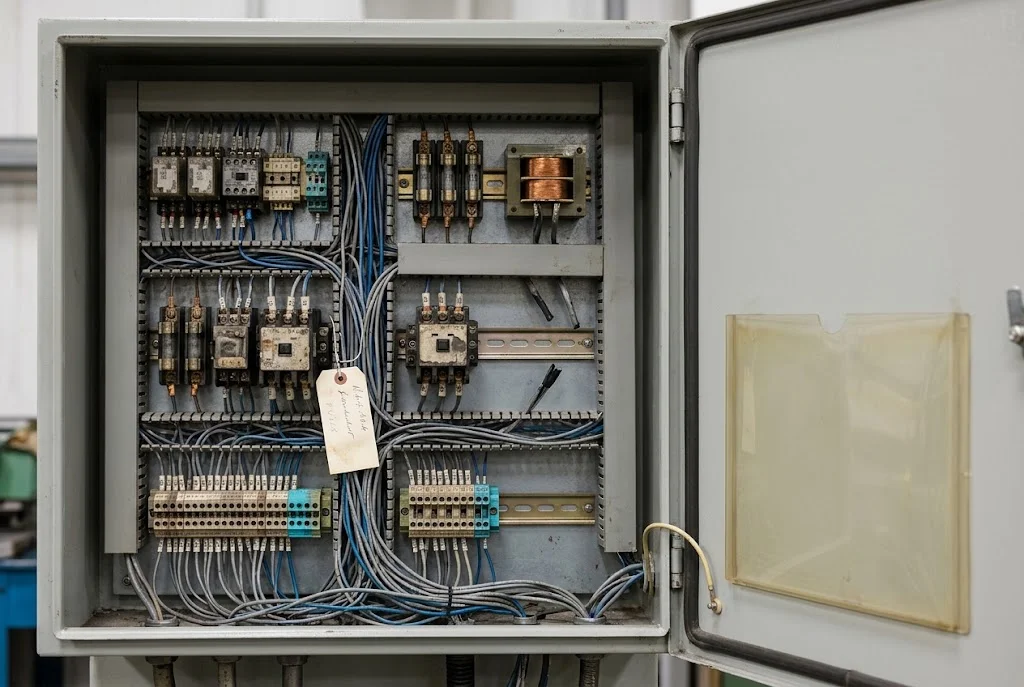
The machine is down, the panel is open, and the drawings are either lost, never existed, or describe a machine that was modified twice before you bought it. This is the normal condition of industrial equipment in a small shop, not an unusual one.
Troubleshooting a control panel without documentation is a different job from following a schematic. It is slower at the start and it is entirely doable, provided it is approached as a sequence problem rather than a wire-tracing problem. What follows is how that actually goes, so you know what you are buying when you call someone for it.
There are only a few reasons, and they all end the same way:
It is worth five minutes of looking before anyone starts, including inside the panel door, where they are frequently taped. A set of drawings, even an inaccurate one, saves real time.
A machine that will not start, stops mid-cycle, or trips out intermittently is usually being told to do that by its own control circuit. The motor is fine, the drive is fine, and something upstream of both has opened a contact.
That is good news, because control circuits are made of a small number of device types, all of which fail in known ways. It is also why replacing the expensive part first is such a reliable way to spend money without fixing anything. Diagnosing the control side is the work covered under electrical controls, and when the fault genuinely is in the motor or the drive, motors, motor controls and VFDs.
The symptom narrows the circuit before anything is opened. A machine that does nothing at all when the start button is pressed is a different problem from one that starts and immediately drops out, which is different again from one that runs for twenty minutes and quits. Each points at a different part of the sequence.
This is why the first questions are about behaviour rather than wiring, and why a clear description from whoever runs the machine is worth more than an hour of probing.
Control circuits are built as a chain of permissions. Power present, guards closed, e-stops released, limits satisfied, no fault latched, start command given, output energised, holding contact sealed in. Any link in that chain that is open stops everything downstream of it.
Finding the open link is a matter of checking the chain in order rather than following conductors around a panel. It is methodical and it converges quickly, which is the whole reason it works without drawings.
Relays, contactors, overloads, timers, safety relays, limit and proximity switches, pressure and temperature switches, drives and small controllers. Most carry a part number, and most part numbers still yield a datasheet, a terminal layout and a replacement, even for equipment well out of production.
Anything learned about the circuit gets written down and left in the panel. A sketch of the control sequence, labelled terminals, and a note of what was found and changed. The second visit to a machine with notes in the door costs a fraction of the first, and that document is the thing most shops are missing.
A control transformer, its fuse, or the supply to it. If the control circuit has no voltage, nothing in it will operate and every device in the panel looks faulty at once.
Mechanical devices that switch thousands of times. Contacts pit and burn, coils fail, auxiliary contacts stop making. A contactor that drops out under load while testing fine at rest is a classic, covered in why a contactor keeps dropping out.
Limit switches full of coolant, proximity sensors knocked out of alignment, door interlocks worn, pressure switches drifted. These are the parts that produce intermittent faults, because they fail by degree rather than all at once.
Sometimes the circuit is correct and it is reporting a genuine problem: a motor drawing too much, a phase lost, a jammed mechanism. Those have their own causes — see why a motor keeps tripping its overload and what causes phase loss on a motor. Resetting protection repeatedly without finding out why is how a motor gets destroyed.
A failed device nobody makes any more does not end the job. It usually means a modern equivalent fitted and the circuit adapted to it, which is ordinary work provided the function it performed is understood first. That understanding is the part that cannot be skipped.
Jumpers left in, interlocks bypassed to keep production running, a device replaced with something that nearly matches. These are common and they matter, both because they mislead the next person and because a bypassed safety device is a bypassed safety device regardless of why it happened.
A machine bought at auction or brought in from overseas carries its own set of problems on top of the missing paperwork: a supply voltage or frequency that does not match what is in your building, three-phase requirements in a single-phase shop, a different control voltage, and components that are not distributed here.
Most of it is solvable and it is better established before the machine is on the floor than after. The supply side of that is in running three-phase equipment in a single-phase shop, and the connection and relocation work under equipment and machine wiring.
Undocumented troubleshooting is billed for time, because the work is the diagnosis. What shortens it: a clear symptom description, access to the machine, someone available who knows how it normally runs, and any paperwork that does exist. What lengthens it: a machine that has been partly disassembled before anyone arrived, an intermittent fault that is not currently happening, and parts that have already been swapped at random.
How a diagnostic call is structured is set out in what electrical troubleshooting costs, and the broader service in electrical troubleshooting.
Yes. It is the normal case on older and used equipment. The sequence of a control circuit can be established by testing it, and most faults are found in the first part of that process rather than the last.
Rarely. Control components are largely generic in function even when the part number is dead, and a modern equivalent can usually be fitted. What ends a machine is mechanical wear or a proprietary controller with no documented behaviour, not a failed relay.
That is the most expensive diagnostic method available and it frequently does not work, because the fault is often in the control circuit that commands them. Drives and motors do fail, and testing says which — what causes a VFD overcurrent fault covers the drive side.
Yes, and it is better raised than discovered. Bypassed interlocks are common on production equipment and they need to be dealt with deliberately rather than left in place because the machine is running.
Drive work has included Schneider Altivar, TECO and Lenze. Grasse Electric is an independent electrical service contractor, not an authorized distributor or factory service provider.
Yes, and on a machine you intend to keep it is worth asking for. A control sequence sketch and labelled terminals left in the panel door turn every future fault on that machine into a shorter call.
Call 403-872-8698 or send the details through the service request form. The symptom, a photo of the nameplate and a photo of the open panel are enough to say what the work is likely to involve.
Related work is covered under industrial electrical and commercial electrical, for machine shops and light industry across Central Alberta, with local detail on the Red Deer page.
Grasse Electric serves Red Deer, Red Deer County, Blackfalds, Sylvan Lake, Penhold, Springbrook, Innisfail, Lacombe, Ponoka and Morningside.
Written by Todd Grasse, Red Seal Journeyman Electrician, Grasse Electric — Red Deer, Alberta. Published October 28, 2026.
Call for service, or send us the details and photos and we'll take a look.